
Crying for justice is a site-specific installation by Haroon Gunn-Salie presented on the unmarked site near the historic gallows at the Castle of Good Hope in Central Cape Town.
The installation is made up of 118 graves excavated into the landscape, symbolising the 117 known activists killed in detention by apartheid security forces. The last grave acknowledges activists killed in detention and who remain unaccounted for.
The sculptural graveyard highlights the need to dig up the past to reveal the truth behind these brutal killings and is intended to remain in the landscape until the truth is revealed.
When viewed from the rampart elevation of the Castle walls, the installation spells the word JUSTICE as a reverberating call to continue the fight for truth, justice and accountability in post-apartheid South Africa, and for the prosecution of those responsible for these politically-motivated crimes against humanity.


CRYING FOR JUSTICE LIVESTREAM PUBLIC DISCUSSION
Haroon Gunn-Salie in partnership with the South African Coalition for Transitional Justice (SACTJ) presents a public discussion about Crying for justice.
SACTJ is made up of 13 NGOs and also individual members committed to addressing the unfinished business of the TRC.
Speakers include Mary Burton, Howard Varney, Yasmin Sooka, Kylie Thomas, Shirley Gunn and Haroon Gunn-Salie.

Virtual tour
Crying for justice is proudly supported by


Press
-
Call for justice for victims of apartheid violence
During a virtual public discussion on Monday evening, Gunn-Salie said the site-specific installation is made up of 118 graves excavated into the landscape, symbolising the 117 known activists killed in detention by Apartheid security forces. The last grave is to acknowledge activists killed in detention and who remain unaccounted for.
-
On 27 September 1969, Imam Abdullah Haron – an outspoken Muslim cleric in South Africa – died in police detention. Abdullah Haron was the only Muslim cleric in Cape Town who used his sermons to speak out against apartheid policies and laws. His family do not accept the official conclusion that he fell down the stairs. And, to mark 50 years of his death, they want the government to commission a new inquest, which they say will uncover torture and murder. At the centre of the family’s renewed push for justice will be a series of artworks by visual artist Haroon Gunn-Salie.
-
The imam who died fighting racism in South Africa
Penny DaleBacking the campaign is visual artist Haroon Gunn-Salie - who is named in honour of the imam and has made several art works memorialising his life and death.
Gunn-Salie's latest work, Crying for Justice, is an installation in the grounds of the Castle of Good Hope in Cape Town - a symbolic burial ground of 118 unmarked graves, one for each of the people who he says died in detention during apartheid, including Imam Haron.
They were all held without trial - and the police said they fell down stairs, slipped in showers, or took it upon themselves to jump out of windows.
'A cry to the courts'
No-one has ever been held responsible for any of those deaths in detention,and it's a sore, open wound for the families.
-
Beyond 1976: Crying for justice through art
Atiyyah KhanCrying for Justice by artist Haroon Gunn-Salie is a site-specific installation crafted as a burial ground with 118 unmarked graves - one for each person who died in police custody during apartheid - including among them graves for Imam Haron, Ahmed Timol and Steve Biko. Placed in the grounds of the historic gallows of the Castle of Good Hope in Cape Town, when viewed from above the graves spell out the word JUSTICE.
-
Free street art festival wows Capetonians
Among the artists showcasing their work is Haroon Gunn-Salie, who presents Crying For Justice, a site-specific installation on the historic gallows site at the Castle of Good Hope.
He gained international exposure last year when his installation of sculptures Senzenina? (What have we done?), which depicts the mineworkers who were slain in the Marikana massacre, was displayed in London’s Regents Park alongside the work of renowned artists.
“Created as an immersive sculptural graveyard, the public is encouraged to walk through and between the unmarked graves contemplating the lives and deaths of the likes of imam Abdullah Haron, Ahmed Timol, Bantu Stephen Biko and Dr Neil Aggett,” he said.

Additional artworks in the Crying for justice project
Amongst men
2014
M1, fiberglass, gut, sound
Variable dimensions
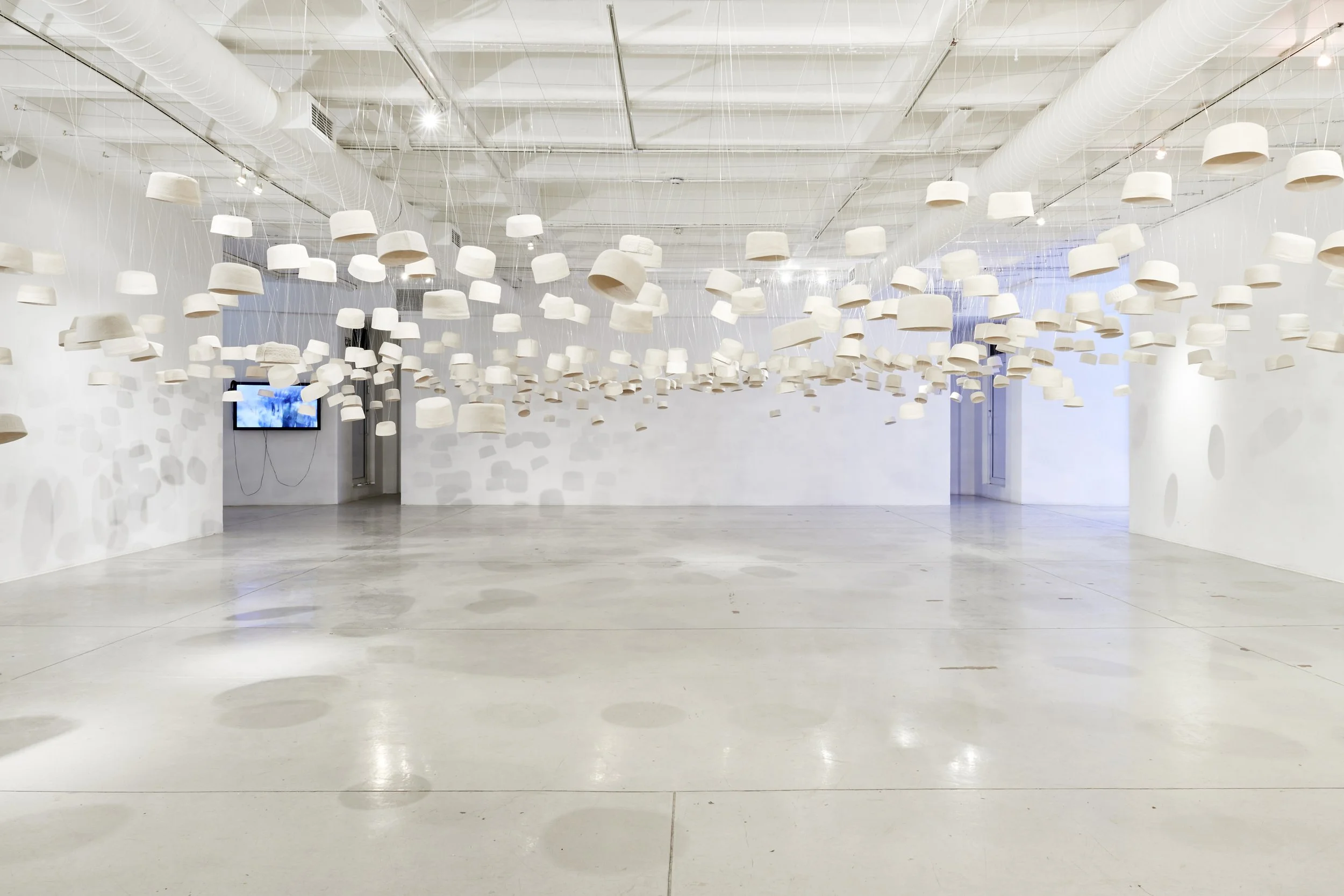
Amongst Men is a sculptural installation considering the figure of Imam Abdullah Haron, and the intersecting histories of Islam and the resistance to colonialism and apartheid in South Africa. Haron was one of the most prominent Muslim clerics of his day and was known for his political involvement at a time when many leaders were silent about apartheid’s injustices.
The installation conceptually recreates Imam Haron’s funeral, which was attended by over 40,000 mourners after he was murdered by apartheid police in 1969, by suspending a series of over 400 individually cast kufiya. It is accompanied by a haunting sound element: a recording of a poem written at the time of the Imam’s untimely death by James Matthews and read by him in old age.




Smile cries in collaboration with Galiema Haron, 2015
M1, fiberglass, resin, steel
2400 x 900 x 600 mm
Smile-cries is created through extensive interviews with Galiema Haron, the widow of Imam Abdullah Haron, who passed away in 2019 exactly 50 years to the day after her husband's killing.
The sculpture is a visualisation of Galiema Haron’s realisation upon seeing her husband’s body in the morgue. Imam had 27 bruises on his body, but she said it seemed the one side of his face was crying, and the other smiling, laughing almost.
The sculpture presents a cast of the body of the artist, wrapped in accordance with Muslim burial tradition, set in a plaster and marble composite.

Remember - I love you in collaboration with Fatiema Haron-Masoet Haron, 2015
Handblown glass, resin, cable
Variable dimensions
Created with Imam’s daughter Fatiema Haron-Masoet, Remember – I love you recalls the indelible message Imam left for her, and for the world. Haron-Masoet was six years old when her father was killed.
Her direct memory of her father is through the eyes of a child. The artwork is made up of a hand-blown light bulb, suspended at child height, with lettering protruding from either side of its surface.
Feedback
We would love to hear from you